The Prototype: A Public-Speaking Exposure
Status. Built on October 24, 2026, and not merged into the project’s main branch. The model that wrote its requirements, designs, and task lists also approved them, under the developer’s directive to work without a human in the loop until a demonstrable product existed. No person has reviewed its code or specifications, and none of its eight entries has an evidence record.
The demo is a web app. A person chooses a condition, passes the screening gate and acknowledges its warnings, and then gives a talk to a virtual audience across five blocks at rising gradients, 10, 30, 50, 72, and 95 by default. A supervisor can step a block down but never up, a stop control is on screen at every moment, and stopping returns to an empty, lit room with the sound off. Nothing listens to the speaker: there is no microphone input of any kind.
It runs on an ordinary screen, in a headset’s browser through WebXR, or as side-by-side stereo in a phone holder. The audience is heard as well as seen: room tone, rustles, coughs, sighs, murmuring, and laughter are synthesized in code and build with the audience’s reactions, and muting only ever lowers them.
The generator describes the condition as 11 dimensions (Table 1): eight vary the feared stimulus and three the context. Realism is one of them, so the audience grows more lifelike as the gradient rises (Figure 1).
Table 1
Dimensions of the Public-Speaking Parameter Space
| Dimension | Varies | Range | Label in code | Source this page could confirm |
|---|---|---|---|---|
| Audience size | Stimulus | 0 to 120 people | Documented | Not confirmed |
| Audience disposition | Stimulus | Warm to openly hostile, five steps | Documented | Hostile versus other audiences: Pertaub et al. (2002) |
| Audience gaze | Stimulus | None to all looking at the speaker | Documented | Not confirmed |
| Audience reactions | Stimulus | None to scoffing and laughter, five steps | Documented | Not confirmed |
| Question pressure | Stimulus | None to interruption during the talk | Documented | Not confirmed |
| Evaluation salience | Stimulus | None to a camera and a scoring panel | Documented | Not confirmed |
| Audience proximity | Stimulus | Front row 6 m to 1.2 m away | Extrapolation | None claimed |
| Visual realism | Stimulus | Mannequin to lifelike, five steps | Documented | Non-clinical sample: Girondini et al. (2023) |
| Speech duration | Context | 60 to 600 s | Documented | Not confirmed |
| Speaker salience | Context | Lighting contrast on the speaker, 0 to 1 | Documented | Not confirmed |
| Venue scale | Context | Seminar room to auditorium | Extrapolation | None claimed |
Note. Labels are those the demo’s dimension file assigns. When its citations were checked for this page, one was given with the wrong volume and pages, and the adjustable features attributed to it could not be found in its abstract (Lindner et al., 2021); several others name no source at all. “Not confirmed” means this page could not confirm the source, not that the dimension is unsupported.
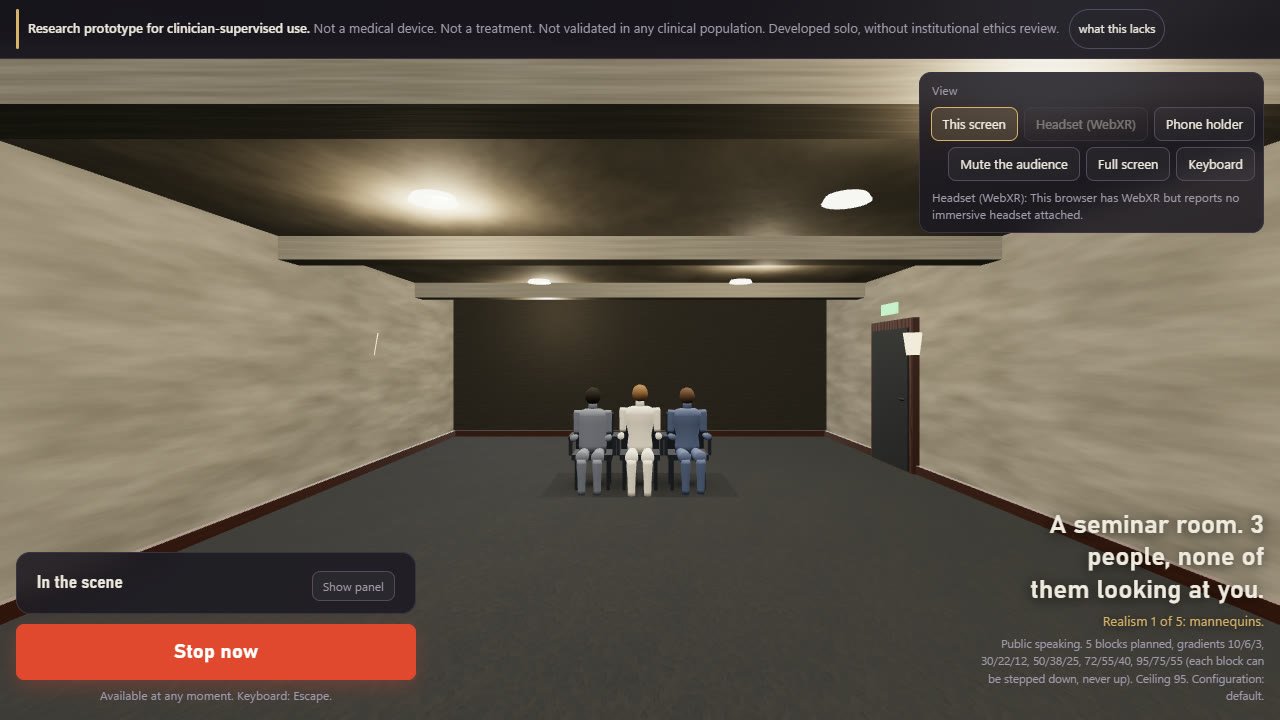
Level 1, mannequins. A seminar room; 3 people, none looking at the speaker.
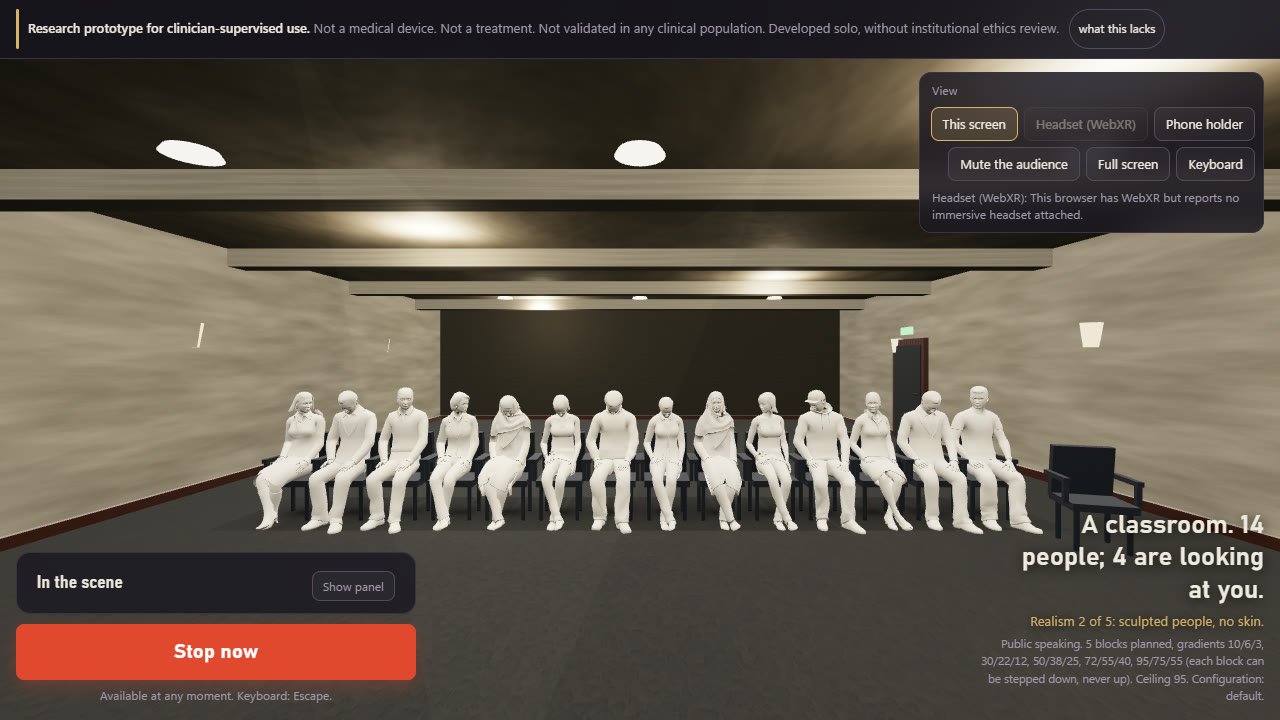
Level 2, sculpted. A classroom; 14 people in matte modeled bodies, 4 looking.
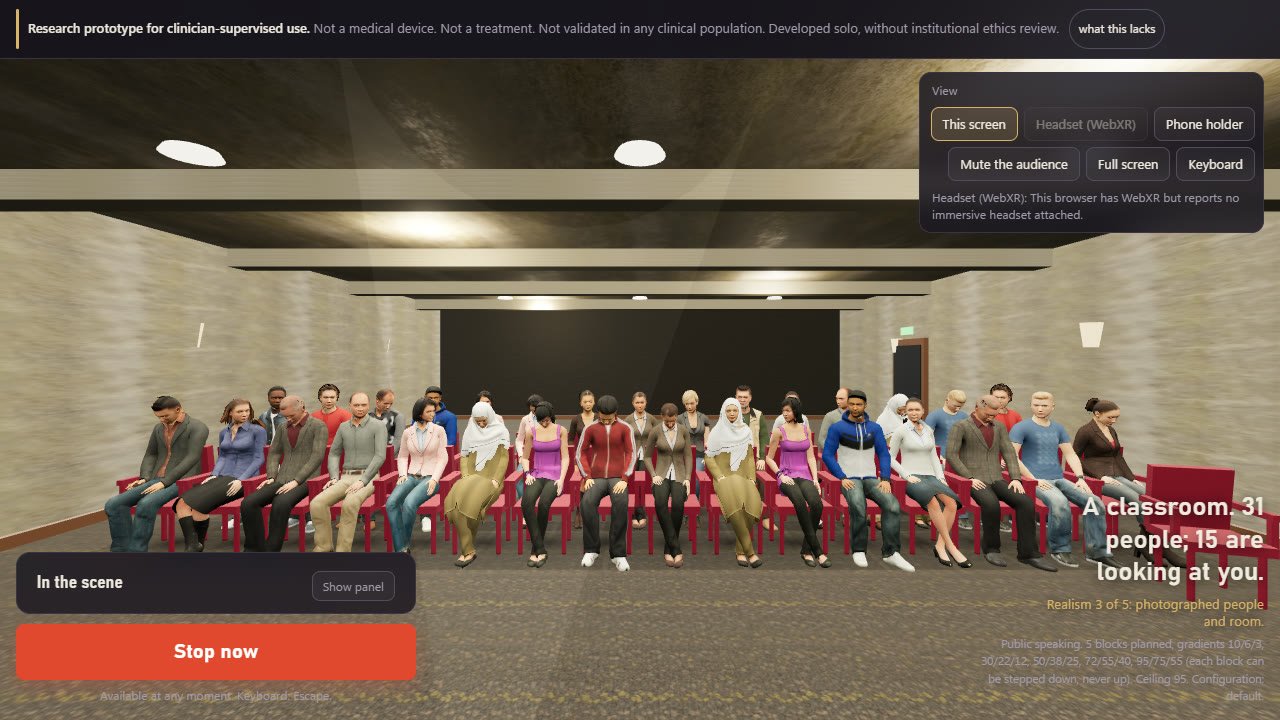
Level 3, textured. A classroom; 31 people with photographed skin and clothing, 15 looking.
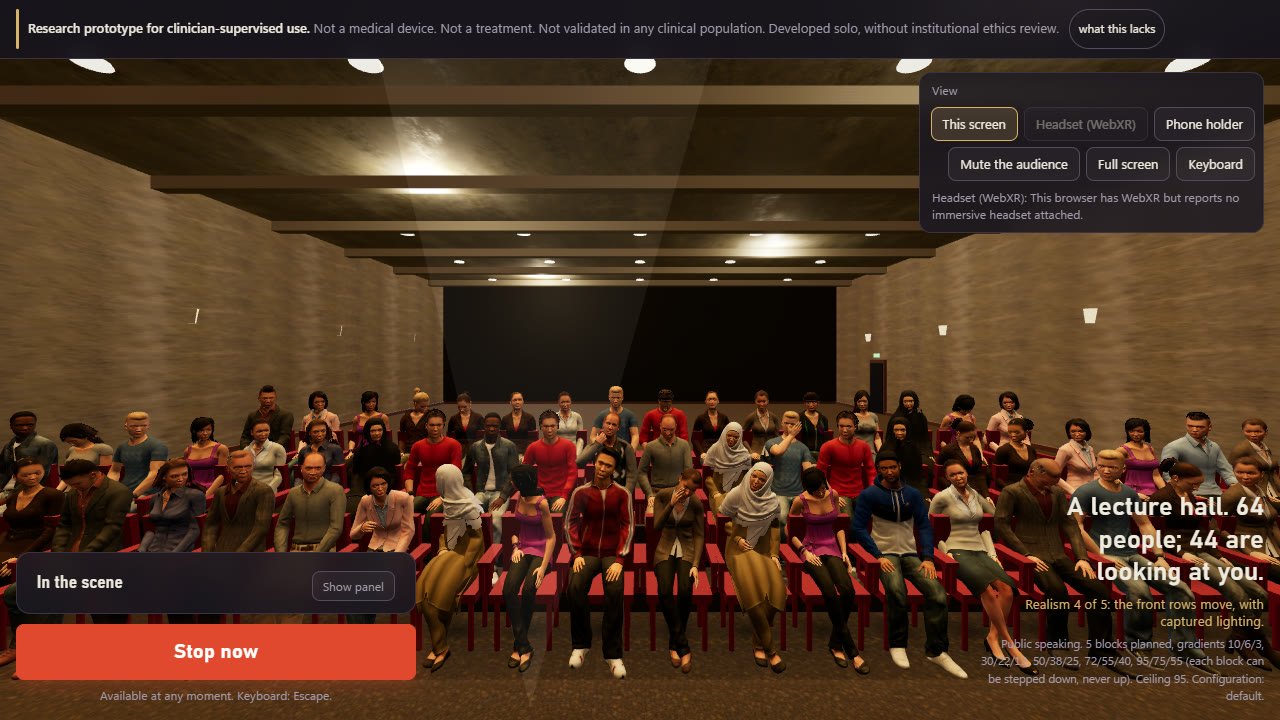
Level 4, animated. A lecture hall; 64 people, the nearest moving and blinking, 44 looking.
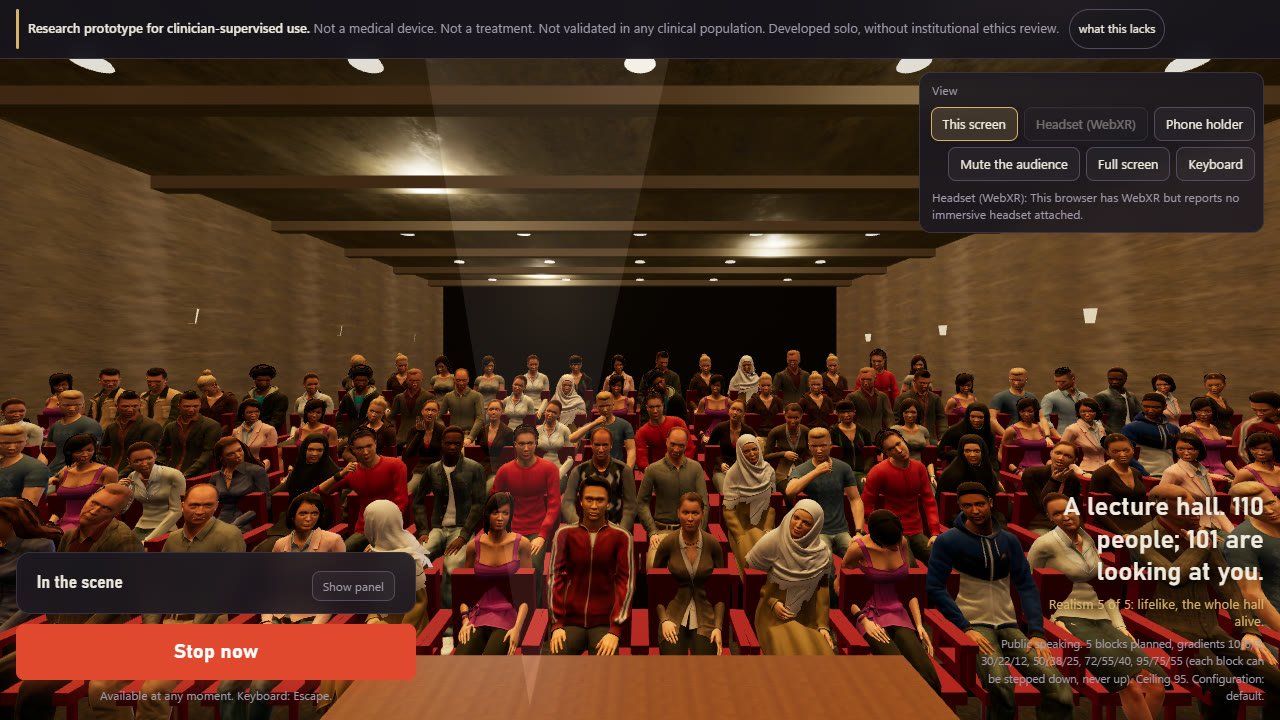
Level 5, lifelike. A lecture hall; 110 people, 101 looking.
Note. One frame per block of the default session, captured in a desktop browser. Realism rises with the gradient, so audience size, gaze, and venue change with it. The modeled people are Microsoft Rocketbox avatars (MIT license, © 2020 Microsoft), modeled by artists rather than scanned from real people; the room photographs and lighting capture are from Poly Haven (CC0). No image or sound in the demo was produced by a generative model.
The Founding Premise Did Not Hold as Stated
The project began with an appealing idea: if AI could generate many different environments, what a person learns during exposure might carry over better to the real world. Before anything was built, eight research agents investigated the clinical, technical, product, regulatory, and privacy questions in parallel, under a rule that nothing entered the report unless a source retrieved during the run confirmed it. Two of them were given the context question independently, so that agreement would mean something.
Both reached the same answer: varying the surrounding environment looked like the weakest-supported lever in the inhibitory learning toolkit for human clinical samples. An early study behind it is a study of conditioned fear in rats (Gunther et al., 1998), and neither agent found a randomized trial in a diagnosed clinical sample showing that varying the environment improves lasting outcome.
Corrected October 25, 2026. A check of this page against its sources found that conclusion too strong. An earlier randomized study in 30 patients with spider phobia found that exposure in several virtual contexts reduced the return of fear (Shiban et al., 2013), and a second head-to-head randomized study, a treatment-analogue study in 134 adults meeting diagnostic criteria for snake phobia, found lower threat expectancy one week after exposure in varied settings, with no difference in approach behavior (Jessup et al., 2025). Both head-to-head studies found an early advantage for varied settings. Only the one below tested again later, and the case against varying the environment rests on that single follow-up, in which varying the spider did produce a lasting reduction. The question is unsettled, not decided against varying the environment. This note was revised the same day: it first said no trial had shown a lasting benefit either way. The evidence review sets out both.
Note. Data from Shiban et al. (2015), a randomized trial with N = 58 patients with spider phobia, which its abstract describes as a treatment analogue study. Varying the feared stimulus also appeared more beneficial on the behavioral approach test, in the short and the long term.
Three further findings narrowed things again. Reviewing the evidence, Craske et al. (2008) concluded that neither how far fear falls during exposure nor where it ends predicts outcome; a later analysis of 516 patients found that falling fear and changing expectancy each predicted outcome on their own, so that conclusion is now contested (Thaon de Saint André et al., 2025). In a single virtual reality exposure session with 121 participants with elevated fear of spiders, larger decreases in fearful expectancy from before to after exposure were associated with better outcomes at 1 week, and on one of the verbal measures at 3 months, while physiological fear reduction during the session generally did not predict outcome (Scheveneels & Carpentier, 2025). And in a laboratory fear-conditioning study, a graded schedule did no better than a random one, while the random schedule produced more violated expectations (Scheveneels, Boddez, Vervliet, et al., 2019). That last result questions whether the smooth ascent a gradient implies is itself what helps.
Dropout is not a particular weakness of virtual reality: across 46 studies, dropout from virtual reality exposure averaged 16%, and the odds of dropping out did not differ significantly from in vivo exposure (Benbow & Anderson, 2019).
What Survived Is Narrower, and Better Supported
What the evidence supports best is control of the feared dimensions themselves, with expectancy measured before and after each block of exposure rather than distress tracked during it. A parametric engine is good at exactly those two things. Generative AI dropped from being the thesis to being a supporting service.
So the generator describes each condition as its own set of dimensions: 11 for public speaking (Table 1) and 10 for heights (Table 2). Those that vary the feared stimulus carry the claim; those that vary the context are kept, and with both head-to-head trials finding an early advantage for them and only one testing whether it lasts, they are an open question an instrument like this could test, not decoration.
What the Evidence Says About Public Speaking
For social anxiety, the comparison with exposure in real life is where virtual reality looks weakest. A meta-analysis of randomized trials that gave both an equal amount of exposure found no significant difference for specific phobia or agoraphobia, but in vivo exposure did better for social phobia, g = −0.50, a pool of three trials (Wechsler et al., 2019).
The trials behind that figure disagree with each other. Anderson et al. (2013) randomized 97 people whose main fear was public speaking to virtual reality exposure, group exposure therapy, or a waitlist: both treatments did better than waiting, did not differ from each other, and held their gains at 12 months. Bouchard et al. (2017), with 59 participants and exposure embedded in 14 sessions of cognitive behavioral therapy, found virtual reality exposure did better than in vivo exposure on the primary outcome, though the virtual reality group started more symptomatic, the groups did not differ on a behavioral test, and the comparison was half the size its power analysis called for. Wechsler et al.’s recomputation rates the first as favoring in vivo exposure and the second as favoring virtual reality.
Delivered as exposure alone rather than inside a broader package of cognitive behavioral therapy, with or without a therapist, virtual reality exposure lowered social anxiety scores compared with waiting or no treatment, SMD = −0.82, 95% CI [−1.52, −0.13], an estimate its authors call uncertain because it rests on five small studies at high risk of bias (Rejbrand et al., 2023). In routine care, without a control group, 23 clients of a private clinic reported substantially less public speaking anxiety after a single 3-hour session followed by an online program, with no change over 3 months (Lindner et al., 2021).
One result cuts against this project’s own thesis. In a study of 43 people afraid of public speaking, anxiety fell across two sessions of virtual reality exposure, but neither the proportion of a person’s feared predictions they judged the scene could test nor being told afterwards whether the audience could have reacted predicted the outcome; the authors concluded that expectancy violation does not straightforwardly explain the effect (Scheveneels, Boddez, Van Daele, et al., 2019). That is the mechanism the heights work leaned on, and the public-speaking condition inherits the open question.
On the audience itself, early studies faced speakers with eight avatars and varied how they behaved: a hostile, bored audience raised speaking anxiety more than a neutral or a positive one (Pertaub et al., 2002; Slater et al., 1999). In a non-clinical sample of 42 adults, more realistic avatars and a human voice each raised self-reported anxiety while giving a talk, though skin conductance did not change (Girondini et al., 2023). A commercial product, CleVR, already gives therapists real-time control of social scenarios in virtual reality, with CE marking, for paranoia, social avoidance, and agoraphobia (CleVR, n.d.).
Where It Started: Heights
The packages beneath the demo were built first, for fear of heights. The discovery run chose heights as its first target because, in trials giving both an equal amount of exposure, virtual reality and in vivo exposure have not differed significantly for specific phobia: four trials, one of them on heights (Wechsler et al., 2019). Four of the 10 heights dimensions can be moved below (Figure 3).
Note. Elevation is drawn compressed; the figures are true values. A diagram of the parameters, not the scene a participant would see.
Table 2
Dimensions of the Acrophobia Parameter Space
| Dimension | Varies | Range | Source |
|---|---|---|---|
| Elevation | Stimulus | 0 to 60 m | Documented |
| Edge proximity | Stimulus | 3 m away to at the edge | Documented |
| Barrier | Stimulus | Full wall, chest rail, knee rail, none | Extrapolation |
| Openness underfoot | Stimulus | Opaque floor, grating, glass, open drop | Documented |
| Support stability | Stimulus | Solid floor to narrow beam | Documented |
| Task demand | Stimulus | None to placing an object at the edge | Documented |
| Wind speed | Context | 0 to 12 m/s | Extrapolation |
| Bystanders | Context | 0 to 12 | Extrapolation |
| Duration | Context | 30 to 600 s | Documented |
| Setting | Context | Atrium, rooftop, bridge, scaffolding, cliff | Documented |
Note. Labels are the generator’s. Documented = appears as a task or step in a published behavioral approach test or exposure protocol (Freeman et al., 2018; Steinman & Teachman, 2014; Wannemueller et al., 2019). Extrapolation = inferred from task descriptions. None of these studies varied any dimension independently of the others. An October 2026 check found three labels that do not match their sources: lowering the barrier was one of Freeman et al.’s graded tasks, so it is better supported than its label; the floor states beyond an ordinary floor do not appear in the sources, which asked people to look down at targets and in one case used grid floors throughout; and none of them varied duration. The generator’s citations for those three now say what the sources did; the labels themselves were kept by decision, because they are carried into the generator’s reference files.
Studies outside the clinic have crossed height with distance from the edge, but no study the research found has broken a treatment hierarchy for fear of heights into separate dimensions and compared their strength, which is a gap this instrument could address.
For heights, the strongest results come from systems far simpler than this one (Table 3).
Table 3
Published Results for Fear of Heights Without a Therapist
| Study | System | Therapist delivering treatment | Effect size |
|---|---|---|---|
| Freeman et al. (2018) | Automated virtual reality with a virtual coach, about six 30-minute sessions planned, 4.7 attended on average | None | d = 2.0 |
| Donker et al. (2019) | Self-guided smartphone app with cardboard goggles | None | d = 1.14 |
| Bentz et al. (2021) | Stand-alone smartphone app, six 30-minute home sessions, tested at a real lookout tower | None | d = 1.3 |
Note. Effect sizes are Cohen’s d as each study reported them, on different outcome measures, including the Heights Interpretation Questionnaire in Freeman et al. (2018) and a behavioral avoidance test at a real height in Bentz et al. (2021), so they are not directly comparable. In Freeman et al. (2018), a graduate psychologist was present to help fit the headset and for safety but did not deliver therapy; the trial was funded by Oxford VR, which owns the treatment and with which several authors were affiliated, and by a National Institute for Health and Care Research center. Donker et al.’s effect is at the end of 3 weeks of treatment; the waitlist then received the app, so there is no controlled follow-up, and two of its authors developed the app, which was intended for commercial release. In Bentz et al. (2021), tower performance did not differ after a single 1-hour session, though questionnaire-rated anxiety was already lower; the effect shown compares 22 app users with 25 controls who had no further intervention.
If the only aim were to help people with a fear of heights, the right decision would be to license an existing protocol and stop. Project Gradient is justified only as a research instrument: one that can ask which dimensions of a feared situation matter, and whether varying them finely changes what people expect, questions the systems above were not built to answer.
Generation Belongs Before the Session, Not in It
Once generation stopped being the mechanism, it could leave the live session. That one decision resolves three unrelated problems:
- Privacy. A prompt describing a person’s fears, sent to a hosted model, is very likely a disclosure of protected health information. U.S. guidance classes a cloud provider that stores such information as a business associate even when it holds only encrypted data and not the key (U.S. Department of Health and Human Services, n.d.). The major model providers now offer such agreements for named services, so the reason to keep these prompts out is no longer that vendors will not sign one; it is that nothing needs to be sent.
- Reproducibility. Hosted models change without notice, so a stored seed may not rebuild the same scene next week.
- Review. Content that first exists mid-session cannot have been checked before someone sees it.
So generation runs before the session, from de-identified parameters, into a fixed bank a person has reviewed. In the current prototype, no generative model produces scene content at all: scenes are built by code from their parameters, with modeled and photographed assets at the higher realism levels.
Table 4
Feasibility of AI Generation by Tier and Delivery Platform
| Generation tier | Quest 3 standalone | PC streamed to headset | Cloud |
|---|---|---|---|
| Rendering content generated beforehand | Feasible now | Feasible, with headroom | Feasible, unnecessary |
| Generating content during a session | Not feasible | Partly, for asset and audio swaps | Possible, disfavored on privacy |
| Frame-by-frame generated worlds | Not viable | Not viable in 2026 | Not viable in 2026 |
Note. Verdicts from the project’s discovery run in September 2026, combining evidence on generative capability, headset platform limits, and regulatory and privacy constraints. Frame-by-frame world models failed on three counts at once: no stereo output, no headset integration, and no reproducible sampling. As of October 2026 one research model generates stereo video, offline, at about 5 frames per second (Sun et al., 2026), but none streams to a headset interactively and none documents reproducible regeneration, which alone rules them out for clinical research.
The renderers are built on three.js and WebXR, so one codebase reaches a phone, a desktop browser, and the Quest 3 browser. The discovery run had recommended Unity for a headset-first plan; a later decision to work phone-first reversed that.
What Has Been Built
The Foundation, Merged
Eight entries, landed on September 4 and 5, 2026, built seven TypeScript packages with no runtime dependencies, all for fear of heights. At the last of them, 818 automated tests passed across the seven.
- RM32
Generator
Turns a capped gradient value into a reproducible exposure specification across the 10 dimensions. Every output carries a seed and a hash and is checked against committed reference files. No field can accept a physiological signal.
- RM37
Renderer
Turns a specification into a height scene in the browser and through WebXR. The mapping from specification to geometry runs without a browser so it can be tested, and a missing dimension is reported, never filled with a default.
- RM38
Session Runtime
Expectancy before and after each block. Distress ratings recorded and never used to decide anything. An exit that works from every state with no confirmation step. The session is its own event log, so replay is exact.
- RM42
Session App
One page joining the three. The stop control is a required part of every view, so no screen can be drawn without it.
- RM44
Screening Gate
Eight items, each with a citation and a label saying whether it rests on published work or is a product decision. A session cannot start without a clearance, and no individual answer leaves the screening package.
- RM46
Supervisor Console
Shows a session as it runs and can lower or stop it. It cannot raise it: a test walks 364 command sequences and fails if any of them raises the gradient.
- RM47
Provenance Disclosure
A statement of how the work was produced, derived from the repository itself and checked against it, so it cannot quietly go stale.
- RM48
Session Setup
A supervisor configures a session before it starts. The configuration is validated whole or refused whole, and it can narrow the safety envelope but never widen it.
The Public-Speaking Demo, Not Merged
Eight more entries, built on October 24, 2026, without a human in the loop, added the second condition and made it demonstrable. At the last of them, 1,068 automated tests passed on the unmerged branch.
- RM49
A Second Condition
Public speaking added to the generator behind a condition registry, without changing a byte of any heights specification it already produced.
- RM50
Venue Renderer
A new package that maps a specification to a room, a stage, and a seated audience, with the mapping testable without a browser, and on-screen, headset, and phone-holder presentation.
- RM51
One App, Two Conditions
A chooser, and both conditions running through the same screening gate, session rules, stop control, record, and export.
- RM52
Venue Fidelity
Modeled bodies, room architecture, and contact shadows, shown to be cosmetic because no specification-to-scene mapping and no reference file changed.
- RM53
Audience Audio
Reactions made audible with sound synthesized in code and no recordings, with no input path of any kind and a scan for every browser API that could receive audio.
- RM54
Stage-Ready Demo
Runnable unrehearsed on a laptop and projector in under 5 minutes, with every control reachable at 1280 × 720 and a script for presenting it.
- RM55
Graded Realism
Realism became a dimension, with modeled people, photographed surfaces, captured lighting, and animated front rows, loaded only from the app’s own server.
- RM56
Crowd Polish and a Fifth Level
Smoother crowd motion, a seated modeled observer, and a lifelike top level with 48 people in captured motion.
Entry numbers are as the branch records them. They were assigned locally and collide with another project’s entries of the same numbers in the central roadmap, so they will need renumbering before the branch is merged.
Rules the Code Enforces
The project’s boundaries are written as tests, so breaking one fails the build rather than relying on someone remembering it. The demo keeps every one of them.
- Nothing reads the person. There is no field for a physiological signal, no microphone, and no speech recognition, and scans check every package for any of them, including inside compound names and browser audio APIs.
- Reported distress is recorded and inert. Nothing reads it to choose a gradient, because fear falling within a session does not predict outcome.
- The supervisor lowers and stops, and never raises. Raising exposure from outside a participant’s control is the action most in need of clinical validation, and there is none.
- Exit has no precondition. It is available from every state, with no confirmation and no dependency on the console; in the demo, the Escape key and, in a phone holder, a tap anywhere also stop.
- Nothing is generated without a seed and a manifest, so any scene can be rebuilt exactly.
- The app makes no network request beyond its own files, and a test asserts it.
- Interface text is scanned for efficacy claims. What a participant gives is called an acknowledgement, because there is no study and no ethics board for them to agree to.
What Has Not Been Done
Everything above describes software and a review of the literature. None of it has met a person. The project’s provenance disclosure keeps these statements apart from anything the repository can check, because they rest on one person’s word:
- No human participant has used this software at any point.
- No clinician has reviewed the exposure design, the screening items, or any interface text.
- There is no institutional review board approval, and no application has been made.
- There is no clinical collaborator. The project is developed by one person who is not a licensed clinician.
- No part of this software has run on a Meta Quest headset. All verification has been in a desktop browser or headless.
- No data from any person has been collected, stored, or transmitted by any version of this software.
- The AI work was directed and reviewed by Adam Mosley, who read the summaries and approved each entry, but did not independently re-verify every citation or line of code.
Attested by Adam Mosley on September 5, 2026. These statements were made before the public-speaking demo existed and have not been re-attested since.
The public-speaking demo has run only in a desktop browser on one workstation, where the four lower realism levels held 165 frames per second and the highest held about 105 to 118. It has not run on a headset or a phone. Its avatar textures are estimated, not measured, at about 680 MB of memory, likely too much for a Quest 3 as they stand. No person has listened to its audio. Its screening still asks about fear of heights before a public-speaking session.
The heights renderer’s frame budget on a Quest 3, a sustained 72 frames per second, has not been measured. It is not met and not failed; it is unmeasured.
Four of the nine entries up to RM48 have no evidence record: RM32, RM37, RM38, and RM42. None of the eight demo entries has one either. The work may have been done well, but the repository cannot show it, and no record has been written after the fact.
Defects Found in AI-Produced Work
The project keeps a register of what went wrong in AI-produced work, and a fixed defect is never removed from it. Some of what it records:
- A cryptographic hash in a test was invented and presented as a known-correct reference. A check against a real implementation disagreed.
- A literature match was accepted because the author and journal agreed. It was a different 2015 paper.
- The research domain asked to list contraindications returned no list, and nothing signaled the gap. It surfaced only when the screening gate went looking for it.
- Four safety tests meant to keep physiological signals out of the code could not see inside compound identifiers, so they could not have caught a violation written the way code is actually written.
- In the demo, the scan meant to prove nothing can reach a microphone matched nothing at all, because of an escaping error in how its pattern was written: the second safety scan in the project found passing while checking nothing.
- The heights renderer drew a public-speaking specification as a neutral, ground-level heights scene instead of refusing it, while the session record would have said otherwise.
- A badly distributed hash had clumped crowd positions since the first renderer, leaving four of five bystanders in a heights scene within half a meter of each other. Tests for determinism could not catch it.
- A check of the research against its sources in October 2026 found that between 21% and 40% of the discovery dossier’s decision-relevant claims needed correcting. One resource-library entry named authors, a journal, and a DOI that all belonged to other papers, and four of five sampled claims that no study had done something were false or too broad. The evidence review lists each.
Use of Artificial Intelligence
This section reports what publication-ethics guidance asks authors to disclose when they use generative AI: which tools, what they did, how their output was checked, what was withheld from them, and who is responsible (American Psychological Association, 2025; COPE Council, 2023; International Committee of Medical Journal Editors, 2026). The tools are cited following APA Style’s guidance for generative AI (McAdoo et al., 2025).
Ethics review boards share no single standard for this. Federal advisory guidance addresses research that studies AI, not AI used to prepare a study (Secretary’s Advisory Committee on Human Research Protections, 2022), and institutional guidance asks that AI used within a study be described to participants in plain language (University of Michigan Human Research Protection Program, n.d.), which would apply to this project’s generation service if it were ever used in a study. Following a reporting standard is not ethics review. No ethics board has reviewed this project.
- Tools
- Large language models made by Anthropic. Claude Opus 5 (Anthropic, 2026c) ran the research synthesis, wrote the software through RM48, and built the first five entries of the public-speaking demo. After a rate limit interrupted the first research run, Claude Sonnet and Claude Haiku models (Anthropic, 2026a), whose versions the run record does not state, completed four research domains and transcribed three data tables. Claude Opus 5.5 (Anthropic, 2026d) built the last three demo entries and wrote, designed, and published this page, working in Claude Code (Anthropic, 2026b).
- What they did
- Searched and summarized the literature, under a rule that no source entered the report unless a page retrieved during the run confirmed it; drafted the requirements, designs, and task lists; wrote the code, the tests, and the documentation; and wrote this page. Nearly every commit in the repository declares an AI co-author.
- What a person did
- Adam Mosley set the questions and made the decisions each foundation specification records, and read the summaries and approved each of those entries. By his own account, he “did not independently re-verify every citation or line of code.” The public-speaking demo was built under his directive to work without a human in the loop, so no person approved its specifications; he watched recordings of it and chose its later direction from options offered.
- How it was checked
- By automated tests, including tests built to fail if a safety rule could not catch a violation; by checks that compare generated documents against the repository; and by the register of defects above. The 20 journal articles cited here were checked against their Crossref records, and PubMed where indexed, on October 24 and 25, 2026, by AI agents rather than a person; several descriptions were narrowed, one claim was removed, and errors were found in the demo’s own citations as a result. On October 25, 2026, eight AI agents checked the research again, claim by claim against its sources, and this page was corrected where they found it wrong; the evidence review sets out how. No clinician or independent reviewer has checked any of it.
- What the tools were not given
- Any data about a participant, because none exists: no data from any person has been collected by any version of this software.
- AI in the scenes
- None. The heights scenes and the demo’s rooms at the lower realism levels are built by code from their parameters, and all of the demo’s sound is synthesized in code. At the higher levels, the people are artist-modeled Microsoft Rocketbox avatars and the room uses Poly Haven photographs and a lighting capture. Those assets are listed in a separate, hashed manifest that the generator’s per-scene disclosure does not yet cover, which is a gap.
- Prompts
- The prompt that began the discovery run and the specification behind each entry are kept in the repository. Full session transcripts are not.
- Authorship
- The AI tools are not authors, because they cannot take responsibility for the work, and they are cited as tools, never as the source of a claim. Responsibility for the project and for this page rests with Adam Mosley.
- Records
- The repository keeps a machine-derived provenance record of all of this, checked against the repository on every change, with run logs and the defect register. The repository is not public.
What It Needs Next
A licensed clinical collaborator and an institutional review board, before anything goes near a participant. Nothing else in the plan substitutes for either. The demo would also need review and merging, and its avatar textures would need to fit a headset’s memory before it could run on one.
For heights, the study question the research points to is whether fine-grained variation of the feared dimensions does better than a single stepped ascent at equal dose, and whether varying the setting adds to it, which neither head-to-head trial has settled beyond the first test after treatment, with change in expectancy as the mediator and a behavioral approach test at a real height as the primary outcome, following Bentz et al. (2021). For public speaking, the evidence sets a harder bar: matched trials favored exposure to a real audience, and expectancy violation did not explain the effect in the one study that tested it. A public-speaking instrument would first need to show what it can vary and measure that a real audience cannot.
Two questions come before either study, and a clinician would settle them on paper: how many dimensions a person can actually manage during a live session, where three may be enough, and which of the dimensions can be separated at all.
References
- American Psychological Association. (2025, August). APA Journals policy on generative AI: Additional guidance. https://www.apa.org/pubs/journals/resources/publishing-tips/policy-generative-ai
- Anderson, P. L., Price, M., Edwards, S. M., Obasaju, M. A., Schmertz, S. K., Zimand, E., & Calamaras, M. R. (2013). Virtual reality exposure therapy for social anxiety disorder: A randomized controlled trial. Journal of Consulting and Clinical Psychology, 81(5), 751–760. https://doi.org/10.1037/a0033559
- Anthropic. (2026a). Claude [Large language model]. https://claude.ai/new
- Anthropic. (2026b). Claude Code [Computer software]. https://claude.com/product/claude-code
- Anthropic. (2026c). Claude Opus 5 [Large language model]. https://www.anthropic.com/claude/opus
- Anthropic. (2026d). Claude Opus 5.5 [Large language model]. https://www.anthropic.com/claude/opus
- Benbow, A. A., & Anderson, P. L. (2019). A meta-analytic examination of attrition in virtual reality exposure therapy for anxiety disorders. Journal of Anxiety Disorders, 61, 18–26. https://doi.org/10.1016/j.janxdis.2018.06.006
- Bentz, D., Wang, N., Ibach, M. K., Schicktanz, N. S., Zimmer, A., Papassotiropoulos, A., & de Quervain, D. J. F. (2021). Effectiveness of a stand-alone, smartphone-based virtual reality exposure app to reduce fear of heights in real-life: A randomized trial. npj Digital Medicine, 4(1), Article 16. https://doi.org/10.1038/s41746-021-00387-7
- Bouchard, S., Dumoulin, S., Robillard, G., Guitard, T., Klinger, É., Forget, H., Loranger, C., & Roucaut, F. X. (2017). Virtual reality compared with in vivo exposure in the treatment of social anxiety disorder: A three-arm randomised controlled trial. British Journal of Psychiatry, 210(4), 276–283. https://doi.org/10.1192/bjp.bp.116.184234
- CleVR. (n.d.). CleVR. Retrieved October 24, 2026, from https://clevr.nl/
- COPE Council. (2023, February 13). Authorship and AI tools [Position statement]. Committee on Publication Ethics. https://doi.org/10.24318/cCVRZBms
- Craske, M. G., Kircanski, K., Zelikowsky, M., Mystkowski, J., Chowdhury, N., & Baker, A. (2008). Optimizing inhibitory learning during exposure therapy. Behaviour Research and Therapy, 46(1), 5–27. https://doi.org/10.1016/j.brat.2007.10.003
- Donker, T., Cornelisz, I., van Klaveren, C., van Straten, A., Carlbring, P., Cuijpers, P., & van Gelder, J.-L. (2019). Effectiveness of self-guided app-based virtual reality cognitive behavior therapy for acrophobia: A randomized clinical trial. JAMA Psychiatry, 76(7), 682–690. https://doi.org/10.1001/jamapsychiatry.2019.0219
- Freeman, D., Haselton, P., Freeman, J., Spanlang, B., Kishore, S., Albery, E., Denne, M., Brown, P., Slater, M., & Nickless, A. (2018). Automated psychological therapy using immersive virtual reality for treatment of fear of heights: A single-blind, parallel-group, randomised controlled trial. The Lancet Psychiatry, 5(8), 625–632. https://doi.org/10.1016/s2215-0366(18)30226-8
- Girondini, M., Stefanova, M., Pillan, M., & Gallace, A. (2023). Speaking in front of cartoon avatars: A behavioral and psychophysiological study on how audience design impacts on public speaking anxiety in virtual environments. International Journal of Human-Computer Studies, 179, Article 103106. https://doi.org/10.1016/j.ijhcs.2023.103106
- Gunther, L. M., Denniston, J. C., & Miller, R. R. (1998). Conducting exposure treatment in multiple contexts can prevent relapse. Behaviour Research and Therapy, 36(1), 75–91. https://doi.org/10.1016/s0005-7967(97)10019-5
- International Committee of Medical Journal Editors. (2026). Recommendations for the conduct, reporting, editing, and publication of scholarly work in medical journals. https://www.icmje.org/recommendations/
- Jessup, S. C., Armstrong, T., Hord, C. M., Dalmaijer, E. S., & Olatunji, B. O. (2025). A multilevel examination of an inhibitory retrieval approach to exposure: Differentiating the unique and combined effects of multiple-context and multiple-stimulus cues. Journal of Behavior Therapy and Experimental Psychiatry, 86, Article 101986. https://doi.org/10.1016/j.jbtep.2024.101986
- Lindner, P., Dagöö, J., Hamilton, W., Miloff, A., Andersson, G., Schill, A., & Carlbring, P. (2021). Virtual reality exposure therapy for public speaking anxiety in routine care: A single-subject effectiveness trial. Cognitive Behaviour Therapy, 50(1), 67–87. https://doi.org/10.1080/16506073.2020.1795240
- McAdoo, T., Denneny, S., & Lee, C. (2025, September 9). Citing generative AI in APA Style: Part 1—Reference formats. APA Style. https://apastyle.apa.org/blog/cite-generative-ai-references
- Pertaub, D.-P., Slater, M., & Barker, C. (2002). An experiment on public speaking anxiety in response to three different types of virtual audience. Presence: Teleoperators and Virtual Environments, 11(1), 68–78. https://doi.org/10.1162/105474602317343668
- Rejbrand, C., Fure, B., & Sonnby, K. (2023). Stand-alone virtual reality exposure therapy as a treatment for social anxiety symptoms: A systematic review and meta-analysis. Upsala Journal of Medical Sciences, 128. https://doi.org/10.48101/ujms.v128.9289
- Scheveneels, S., Boddez, Y., Van Daele, T., & Hermans, D. (2019). Virtually unexpected: No role for expectancy violation in virtual reality exposure for public speaking anxiety. Frontiers in Psychology, 10, Article 2849. https://doi.org/10.3389/fpsyg.2019.02849
- Scheveneels, S., Boddez, Y., Vervliet, B., & Hermans, D. (2019). Modeling hierarchical versus random exposure schedules in Pavlovian fear extinction: No evidence for differential fear outcomes. Behavior Therapy, 50(5), 967–977. https://doi.org/10.1016/j.beth.2019.03.001
- Scheveneels, S., & Carpentier, N. (2025). Underlying working mechanisms of virtual reality exposure: Exploring the role of fearful expectancies and habituation. Behavior Therapy, 56(3), 555–565. https://doi.org/10.1016/j.beth.2024.08.004
- Secretary’s Advisory Committee on Human Research Protections. (2022, July 21). Considerations for IRB review of research involving artificial intelligence. U.S. Department of Health and Human Services. https://www.hhs.gov/ohrp/sachrp-committee/recommendations/attachment-e-july-25-2022-letter/index.html
- Shiban, Y., Pauli, P., & Mühlberger, A. (2013). Effect of multiple context exposure on renewal in spider phobia. Behaviour Research and Therapy, 51(2), 68–74. https://doi.org/10.1016/j.brat.2012.10.007
- Shiban, Y., Schelhorn, I., Pauli, P., & Mühlberger, A. (2015). Effect of combined multiple contexts and multiple stimuli exposure in spider phobia: A randomized clinical trial in virtual reality. Behaviour Research and Therapy, 71, 45–53. https://doi.org/10.1016/j.brat.2015.05.014
- Slater, M., Pertaub, D.-P., & Steed, A. (1999). Public speaking in virtual reality: Facing an audience of avatars. IEEE Computer Graphics and Applications, 19(2), 6–9. https://doi.org/10.1109/38.749116
- Steinman, S. A., & Teachman, B. A. (2014). Reaching new heights: Comparing interpretation bias modification to exposure therapy for extreme height fear. Journal of Consulting and Clinical Psychology, 82(3), 404–417. https://doi.org/10.1037/a0036023
- Sun, Y.-T., Huang, Z., Niu, Y., Ma, L., Cao, Y.-P., Ma, Y., & Qi, X. (2026). Stereo world model: Camera-guided stereo video generation (arXiv:2603.17375) [Preprint]. arXiv. https://doi.org/10.48550/arXiv.2603.17375
- Thaon de Saint André, S., Heinig, I., Arolt, V., Bartnick, C., Dannlowski, U., Deckert, J., Domschke, K., Fydrich, T., Goerigk, S., Hamm, A. O., Hollandt, M., Hoyer, J., Kircher, T., Koelkebeck, K., Lueken, U., Margraf, J., Neudeck, P., Pauli, P., Richter, J., . . . Pittig, A. (2025). Same same but different: Threat expectancy change and fear reduction as readouts of exposure rationales are only weakly associated and contribute differentially to treatment outcome in anxiety disorders. Behaviour Research and Therapy, 194, Article 104856. https://doi.org/10.1016/j.brat.2025.104856
- University of Michigan Human Research Protection Program. (n.d.). AI use in human research studies. Retrieved October 24, 2026, from https://hrpp.umich.edu/aiinhumanresearch/
- U.S. Department of Health and Human Services. (n.d.). Guidance on HIPAA & cloud computing. https://www.hhs.gov/hipaa/for-professionals/special-topics/health-information-technology/cloud-computing/index.html
- Wannemueller, A., Gruszka, P., Chwalek, S., Fröhlich, S., Mulders, M., Schaumburg, S., Schöttes, J., Wiederhold, S., & Margraf, J. (2019). Large-group one-session treatment: Feasibility in highly height fearful individuals and predictors of outcome. Frontiers in Psychology, 10, Article 2411. https://doi.org/10.3389/fpsyg.2019.02411
- Wechsler, T. F., Kümpers, F., & Mühlberger, A. (2019). Inferiority or even superiority of virtual reality exposure therapy in phobias?—A systematic review and quantitative meta-analysis on randomized controlled trials specifically comparing the efficacy of virtual reality exposure to gold standard in vivo exposure in agoraphobia, specific phobia, and social phobia. Frontiers in Psychology, 10, Article 1758. https://doi.org/10.3389/fpsyg.2019.01758